Frontiers: Gateways to the Unknown
One only has to look at a map to understand the ambiguities and idiosyncrasies of borders. Are they straight lines drawn with a ruler? Or do they follow the irregular barriers created by nature? In the Alps, for example, borders are defined by various watersheds, so those seemingly arbitrary lines reveal the direction of millennial-old rivers.
Borders speak to those who are willing to listen. Much like a bottle gives shape to the liquid it contains, borders give shape to cultures.

There’s no demarcation but the desert itself at the lonely border between Niger and Algeria. Boundaries dissolve in this immense vastness, yet it is the divide between Sub-Saharan Africa and the Arabic-Berber north. Credit: Media Virbcd.
But, what are borders? Are they arbitrarily drawn lines disrupting the path of carefree globetrotters? Or are they a place to pause with nervous excitement before entering a new world?
To answer such questions, we should consider what it is that entices us to embark on a journey. While each traveller is propelled by their own forces, we are united by an attraction for what is faraway, different or unknown. We search new landscapes, new cultures, and new people. Simply put: we seek “otherness”.
Perhaps part of what distinguishes the traveller from “otherness” is our respective boundaries. Crossing a boundary marks the beginning of something new. We depart from the familiar to experience the unfamiliar.
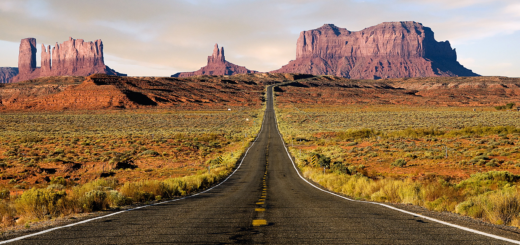
In this way, borders can represent a crucial meaning for the individual. Cormac McCarthy’s legendary Border Trilogy – one of the most fascinating novels I’ve read – speaks to this. The story revolves around a border (the desert between the USA and Mexico), to which all the characters are drawn. Each time one of them crosses, in one direction or the other, their life changes irremediably. McCarthy’s unparalleled merit lies in his masterful ability to consider the powerful dilemma of the individual searching for the border beyond which lies the unfamiliar.
Perhaps something similar happens to us on our own journeys. Like the protagonists of McCarthy’s novel, we all have our frontiers: the limits we seek to reach and cross. When we do, everything within us and around us is different. When we travel, we are seeking the boundary that marks the beginning of the unknown.

The mountains look similar on each side of the frontier between China and Pakistan. But the two valleys – one west, one east – flow like rivers toward their respective plains, where two immense (and radically different) cultures await. Credit: Google Maps.
We live in a time when borders may seem like an outdated legacy. The looser the border, the less documents required, the easier to pass, the less time spent waiting. Even today, one can travel to Morocco with the same ease as London. The world is moving faster and standardized lifestyles are reaching even the remotest areas of the globe.
But this may have its drawbacks: what we gain in terms of time and ease, we lose in terms of authenticity and distance (metaphorical rather than geographical). In a world that has been explored down to the last corner, the restless wanderer looks around disenchanted and longs for a time when the unknown was not only a myth, but a real place.
Perhaps, in the contemporary world, borders can give deeper meaning to our journeys. They can revitalize the experience of travelling by maintaining the distance between cultures in a world that is becoming smaller and simpler to travel. Borders can preserve “otherness” from the tides of globalization and, in so doing, underline the essence of realities different from our own. When we cross into an unknown place, we can be reminded of our own frontiers.

Cristiano Berta
Latest posts by Cristiano Berta (see all)
- Rediscovering Italy Through Wine - October 24, 2017
- 5 of the Most Photogenic but Lesser-known Mountains - September 19, 2017
- Frontiers: Gateways to the Unknown - April 4, 2017

 Almost all the tea houses in